

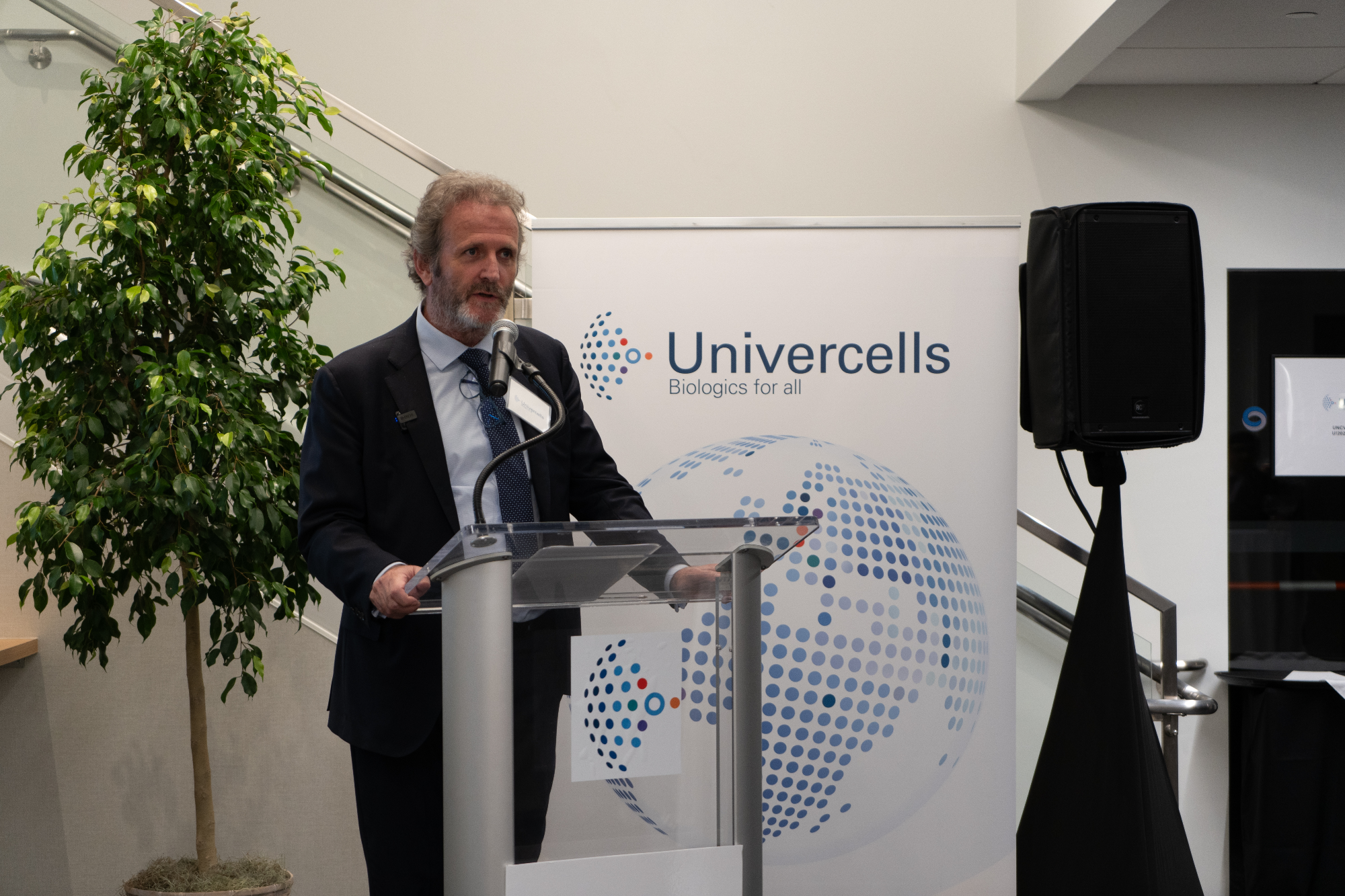

At the 2023 Grand Challenges Annual Meeting, Bill Gates, Co-chair of the Bill & Melinda Gates Foundation, introduced new investments to advance entry to mRNA research and vaccine manufacturing expertise that may help low- and middle-income international locations’ (LMICs) capability to develop high-quality, lifesaving vaccines at scale.
Image Credit: Univercells
The transfer builds on classes the muse has discovered from greater than 20 years of working with vaccine producers in LMICs and the chance to leverage current scientific advances to develop low-cost, high-quality well being instruments that attain extra individuals around the globe. mRNA expertise is taken into account a possible game-changer for a spread of infectious ailments, together with tuberculosis, malaria, and Lassa fever, which disproportionately have an effect on individuals in LMICs. This new expertise can considerably decrease the prices of mRNA research and manufacturing and allow expanded entry—serving to to shut important gaps.
“Putting modern mRNA expertise within the arms of researchers and producers in Africa and around the globe will assist guarantee extra individuals profit from next-generation vaccines,” stated Dr. Muhammad Ali Pate, Nigeria’s coordinating minister of well being and social welfare and a world knowledgeable on vaccines. “This collaboration is an encouraging step that may enhance entry to important well being applied sciences and assist African international locations develop vaccines that meet the wants of their individuals.”
The basis introduced a complete of US$40 million in funding to advance entry to Quantoom Biosciences’ low-cost, mRNA research and manufacturing platform, which was developed with an early-research Grand Challenges grant made to its father or mother firm, Univercells. The Institut Pasteur de Dakar (IPD) and Biovac, research institutes with vaccine manufacturing expertise based mostly in Senegal and South Africa, respectively, will obtain US$5 million every to purchase the expertise and might be ready to use it to develop domestically related vaccines. To additional advance the expertise and decrease prices for commercialization, the muse additionally will present US$20 million to Quantoom Biosciences, guaranteeing LMICs can profit from the next-generation mRNA well being instruments. The Gates Foundation will grant one other US$10 million to different LMIC vaccine producers to be named.
This new funding builds on the muse’s earlier US$55 million funding in mRNA manufacturing expertise.
Expanding our capability to uncover and manufacture reasonably priced mRNA vaccines in Africa is a crucial and needed step in direction of vaccine self-reliance within the area. We welcome this new funding, which can promote the event of lifesaving applied sciences on the continent whereas additionally contributing to world well being safety by increasing the availability and entry to vaccines—permitting us to obtain higher well being fairness worldwide.”
Dr. Amadou Sall, CEO, IPD
mRNA vaccines have less complicated research and manufacturing processes than conventional vaccines, so increasing entry to this next-generation expertise will help international locations like Senegal and South Africa achieve autonomy to uncover and develop low-cost, high-quality vaccines for ailments reminiscent of malaria and tuberculosis which might be per their well being priorities.
“Innovation might be transformative, however provided that it reaches the individuals who want it most,” stated Morena Makhoana, CEO of Biovac. “This collaboration will assist shut important gaps in entry to promising mRNA vaccines in opposition to ailments that disproportionately have an effect on the world’s poorest. It will even help us in our mission to set up end-to-end vaccine manufacturing functionality at scale in Africa for world provide.”
Quantoom’s modular mRNA expertise addresses widespread bottlenecks in present mRNA research and manufacturing applied sciences, making it less complicated and cheaper to use. For instance, the associated fee to produce a vaccine may drop by greater than 50% with Quantoom’s platform in contrast to conventional mRNA expertise. It may additionally considerably scale back the necessity for deeply educated consultants, which continues to be a barrier to vaccine manufacturing in Africa and elsewhere, whereas sustaining and even growing the standard of the product.
“Expanding the provision of reasonably priced, high-quality vaccines that meet the wants of native communities is without doubt one of the greatest methods to enhance world well being outcomes and scale back preventable deaths,” stated Trevor Mundel, president of the muse’s Global Health Division. “By decreasing obstacles to entry for low- and middle-income international locations, we will help guarantee extra individuals around the globe profit from lifesaving well being innovation.”
“The growth of recent vaccines is expensive, useful resource intensive, and concentrated in high-income international locations,” stated José Castillo, CEO of Quantoom Biosciences. “We’re thrilled to associate with IPD and Biovac to scale our expertise in Senegal and South Africa and assist enhance entry to novel mRNA vaccines—certainly one of medication’s most promising new instruments.”
The extra funding for Quantoom builds on an preliminary grant made in 2016 to Univercells in response to a Grand Challenges name for brand new interventions for vaccine manufacturing. The Univercells proposal targeted on creating modular engineering ideas that will facilitate decentralized, small-footprint manufacturing of vaccines.
IPD plans to begin manufacturing important measles and rubella vaccines utilizing Univercells’ unique vaccine manufacturing expertise, increasing the area’s capability to ship routine immunization campaigns.