
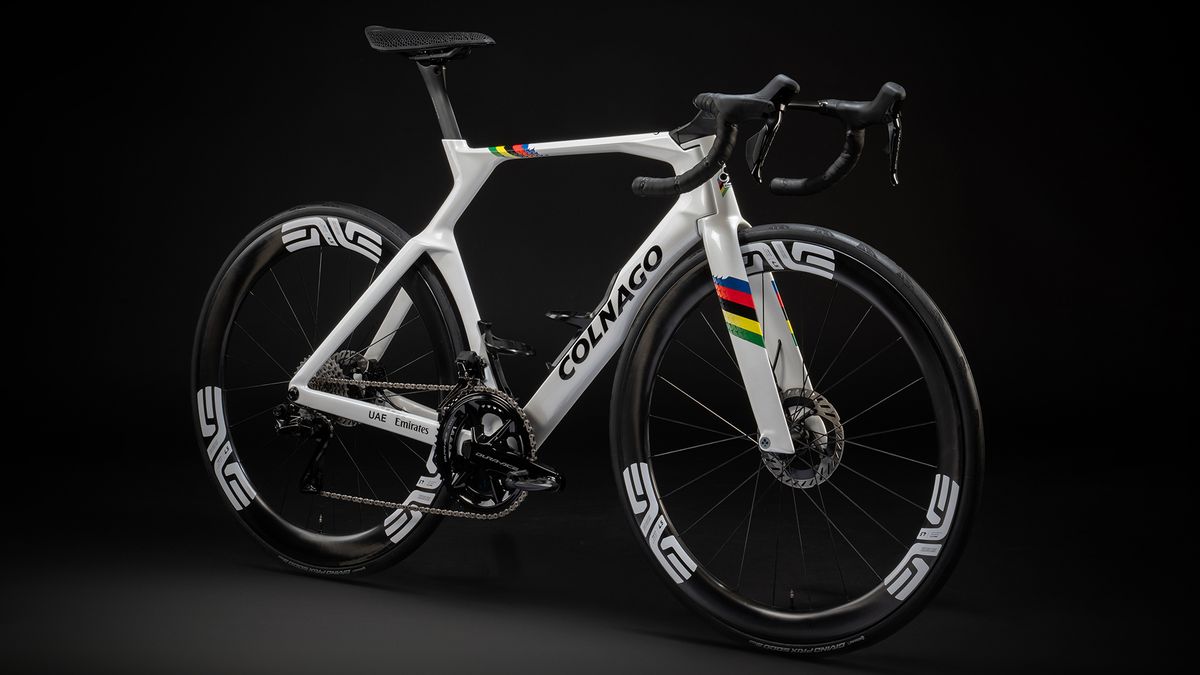
Colnago has launched the Y1Rs, a devoted aero race bike.
Designed for professionals and high amateurs will probably be raced by Team UAE throughout the 2025 season and is, Colnago says, the fruits of years of effort. The result’s a bike that options revolutionary tube shapes, aggressive geometry, its personal built-in aero cockpit and, most strikingly, no essential triangle. That’s proper, Colnago has ditched the essential triangle, changing it with an irregular pentagon.
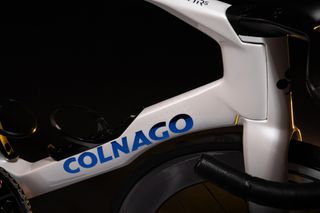
The distinctive head tube and seatpost/seat tube areas are radical departures
(Image credit score: Colnago)
Without an aero bike in its lineup, the Italian model started work on the Y1Rs in half at the behest of the UAE Team who requested an alternative choice to the VR4s for flatter phases, but additionally due to the adjustments to UCI rules concerning frame design.
“We began engaged on this bike in late 2021, which makes it the longest bike improvement in Colnago’s historical past,” says Davide Fumagalli, Head of R&D at Colnago. “We haven’t had an aero bike in our vary since 2016 as a result of, up till now, we haven’t discovered a major profit in efficiency over a bike like the V4Rs.
“So, why did we modify our minds? Because with the change in two UCI guidelines, we recognised the alternative to create a bike that’s considerably higher. The three-to-one facet ratio rule [that stipulated that bar and stem tube depths cannot be more than three times their width] was dropped in favour of imposing an 80mm most and 10mm cross-part, which has enabled us to cut back the frontal space of the bike.
“The different rule allows us to position the seat publish anyplace alongside the high tube; it not must be related to the seat tube.”
If Tadej Pogačar – UAE’s high rider and 2024’s seemingly unbeatable Tour de France winner – comes calling it’s comprehensible that you just’d need to oblige. Colnago selected to reply the calls for for a centered aero bike by difficult the norms of contemporary race bike design. Partnering with two universities on the challenge, the Politecnico di Milano in Italy and Khalifa University in Abu Dhabi, it adopted a scientific strategy that expanded on computational fluid dynamics (CFD) testing in pursuit of larger accuracy.
“We simply did not do the computational fluid dynamics testing that different manufacturers are doing as a result of we discovered that the mathematical modelling behind these checks was not correct sufficient,” says Fumagalli. “We wanted to enhance the mannequin and we did that by growing the variety of strain sensors to 75, which gave us way more information. This helped us to vary path on plenty of concepts, together with the place of the downtube in relation to the wheels.”

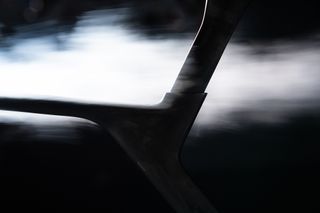
Colnago believes that intensive wind tunnel testing has revealed a mannequin that’s “twice as correct” as some other inside the trade
(Image credit score: Colnago)
A short clarification. A CFD prototype was created however Colnago wished to create a “extra descriptive and correct mannequin”. To achieve this it turned to 3D printing, permitting it to create a number of prototypes that replicated the form and surfaces of the carbon prototype. Using the 3D printed prototypes it drilled plenty of small holes at common distances throughout the floor of the frame, with every gap related by a skinny tube. From right here Colnago might measure the strain of the air on the floor of the bike with nice precision and throughout the whole bike. It then in contrast this information with numbers collected from the CFD fashions to allow them to refine the frame design but additional.
Colnago says it is a mannequin that’s “twice as correct” as the trade commonplace, ensuing in an aero bike that’s “the most aerodynamic UCI-compliant road bike in the World Tour.”
So what improvements did this correct information produce?
The Y1Rs is actually a particular-trying bike, with a number of areas that catch the eye. From entrance to again, the bike appears to be like to make aerodynamic enhancements over the V4Rs. The headset design takes benefit of the new UCI ruling that permits for bigger lateral surfaces. Colnago has elevated the headset space however made the bearings smaller, with the fork containing each an inside part and a frontal part designed to enhance how lateral air flows affect the entrance of the bike.
“The headset is the smallest I’ve ever seen on a road bike, and a part of a really complicated puzzle on the geometry facet,” says Fumagalli.
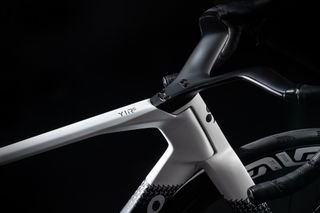
The headset is tiny, and a ‘very complicated puzzle’
(Image credit score: Colnago)
The new CC.Y1 handlebars proceed the theme. Featuring a ‘gull wing’ construction, the tops are raised and indifferent from the centre of the bars and the headset to create a Y-form. This permits the frontal space to be decreased, which interprets to “sooner and cleaner” airflow round the bike. Colnago says it equates to a 19% discount in comparison with the V4Rs.
The horizontal portion of the bars is straight related to the high of the headtube, made doable, Colnago says, by its alternative of carbon layup. It additionally claims the bars are 16% stiffer than “chosen reference handlebars” each vertically and laterally – very best for sprinting. Both the bars and the headtube are ‘paired’ with a bayonet fork.
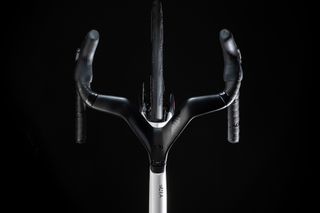
The Y-formed bars have been optimised for aero and sprinting
(Image credit score: Colnago)
This funky-trying downtube can be residence to an built-in bottle cage, with one other on the seat tube. Colnago has designed the cages to match the form of the frame, which reduces the drag brought on by the bottles. The cage additionally helps a Di2 battery. Interestingly although it doesn’t use devoted ‘aero’ bottles.
“We began designing and testing the frame with an built-in bottle however after we mentioned it with the group they mentioned no, we don’t need to combine the bottle as a result of now we have two totally different bikes to consider and riders grabbing bottles from the [team] automotive,” says Fumagalli. “So we needed to revert again to regular bottles and that influenced utterly the form of the downtube.
“But, we had been capable of rework the entire frame understanding that the checks we had been performing with CFD had been already validated, so we had been capable of belief them. We had been capable of make seven totally different bottle cage varieties and perceive which was the finest.”
Space between the wheel and down tube varies for optimum aerodynamics
(Image credit score: Colnago)
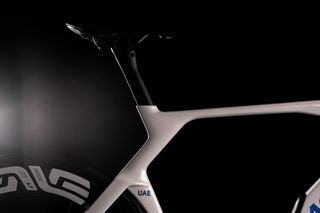
Moving upwards takes you to maybe the most eye-catching space of the Y1Rs – the seatpost junction. Colnago describes it as having the form of “two linked Ys, one in all which is the other way up.” It’s maybe simpler simply to take a look at it. In some methods, it’s not too dissimilar in look to the IsoFlow space on Trek’s aero race bike, the Madone.
Here there’s no gap, however the design, like that used on the Madone, is there in half to make the bike extra compliant. While consolation isn’t usually a precedence for skilled riders, the knock on traditional aero bikes was that in an effort to make them as stiff as doable additionally they grew to become a chore to journey, particularly throughout longer phases or day races. To fight this, Colnago has created the Defy seatpost joint that it says will increase vertical compliance.
Working in conjunction with the Defy seatpost, larger compliance is achieved by growing the angle of the seat publish to get larger radial deflection; in essence, it’s the angle that creates extra consolation. The seat tube additionally follows the form of the rear wheel, which Colanago says allows it to be extra aerodynamically efficient.
“The Y1Rs supplies a way more forgiving journey. Some of our rivals are approaching this in a really totally different approach, utilizing very complicated designs or a suspension system of some form. Our answer doesn’t compromise the lateral or torsional stiffness of the frame,” says Fumagalli.
“Of course, in case you transfer the seat publish it could possibly complicate different areas of the geometry, which could be difficult as a result of riders want to remain in kind of the identical driving place they’re used to (on a standard bike). So, we experimented with many positions for the seat publish earlier than selecting this one. Placing the seatpost the place we did provides more room for airflow to reattach to the bike.”
Colnago’s Davide Fumagalli on UCI guidelines adjustments
(Image credit score: Colnago)
“I feel that the new UCI guidelines that permit the seat publish to be anyplace on the high tube is a dramatic change as a result of it opens up a totally new form for the design of the frame. To be sincere, I’m shocked that nobody else has jumped on board as a result of, on a few of the different preliminary sketches, the frame form was far more radical. So, I feel you will notice one thing very, very good in the subsequent few years as a result of, talking like an engineer, we lastly have some freedom.
“If I might change one additional UCI rule it might be the sloping field regulation that dictates that ‘the high tube might slope, supplied that this component suits inside a horizontal template outlined by a most top of 16 cm’. It wouldn’t essentially make the bike sooner however it might allow us to make bikes with totally different frame shapes. We need the new generations to take a look at a bike and see one thing futuristic. Something with which we’re opening their hearts as a design factor, and never a bike factor. We want to supply them with one thing cool, not a traditional bike with a double triangle. We must showcase to the subsequent era that we’re transferring ahead with a sooner and higher product.”
The launch of a contemporary aero bike wouldn’t be full with out some numbers derived from all that testing. When it involves the Y1Rs the most fascinating of those are made in comparability to the V4Rs. After all, the bike owes its very existence to its means to outperform the V4Rs in sure areas.
Colnago says the new bike is a few 20 watts sooner than the all-rounder. Digging into the numbers in a bit extra element, at 50km/h with a zero-diploma yaw angle, the Y1Rs required 395 watts of output in comparison with the V4Rs. With various yaw angles accounted for, these numbers had been 474 and 499 respectively. Testing was undertaken utilizing a model dressed in WorldTour clothes, with the bikes fitted with two bottle cages and one bottle. Colango says the Y1Rs outperforms its nearest rival too, by a single watt at 0 levels and eight watts utilizing weighted common drag numbers. It doesn’t identify the competitor although, after all.
Another comparability that can curiosity each the professionals and amateurs alike is the comparable weight of the two race bikes. While it’s no shock the V4Rs is lighter, it’s not by maybe as nice a margin as you would possibly assume. Colango says the claimed weight of the Y1Rs for the frame and forks is 1415g, making it simply 242 grams heavier than the VR4s.
Offered in 5 sizes, the Y1Rs adopts totally different geometry to the VR4s.. Both the headtube and seat tube angles are steeper, which Colnago says helps promote a extra ahead-oriented ‘tucked’ rider place. Similarly, the attain and stack ratio has additionally been elevated to accommodate a decrease, extra aggressive place. So will Pogi really feel at residence aboard the Y1Rs?
“The seat place and the bar place are just like Tadej’s present bike, so he’ll match very nicely,” says Fumaggli. “ But the wheelbase is shorter, the headtube angle is totally different, the fork rake is totally different. The group wished one thing quick for sprints, so now we have moved away from our traditional geometry, which is barely extra relaxed and a bit longer.”
But given the success that the UAE group has had aboard the VR4s, how will the Y1Rs match into their racing lineup?
“Team UAE are nonetheless testing each frames with loads of totally different parts, particularly wheels and tyres. There is not any clear switching level between the VR4s and the Y1Rs, quite a bit comes right down to wheel alternative. On some terrain, the VR4s with deeper wheels will likely be sooner than Y1Rs with shallower wheels and vice versa,” says Fumagalli.
“More typically, the Y1Rs is principally for quick-rolling phases and flat phases. I don’t see this bike getting used with very shallow wheels, identical to I don’t see the V4Rs getting used with very deep wheels anymore.”
The Y1Rs is obtainable in plenty of full-construct configurations, beginning at €12,300. It’s additionally out there as a frame equipment solely, priced at €6,710.
For extra data, go to colnago.com