
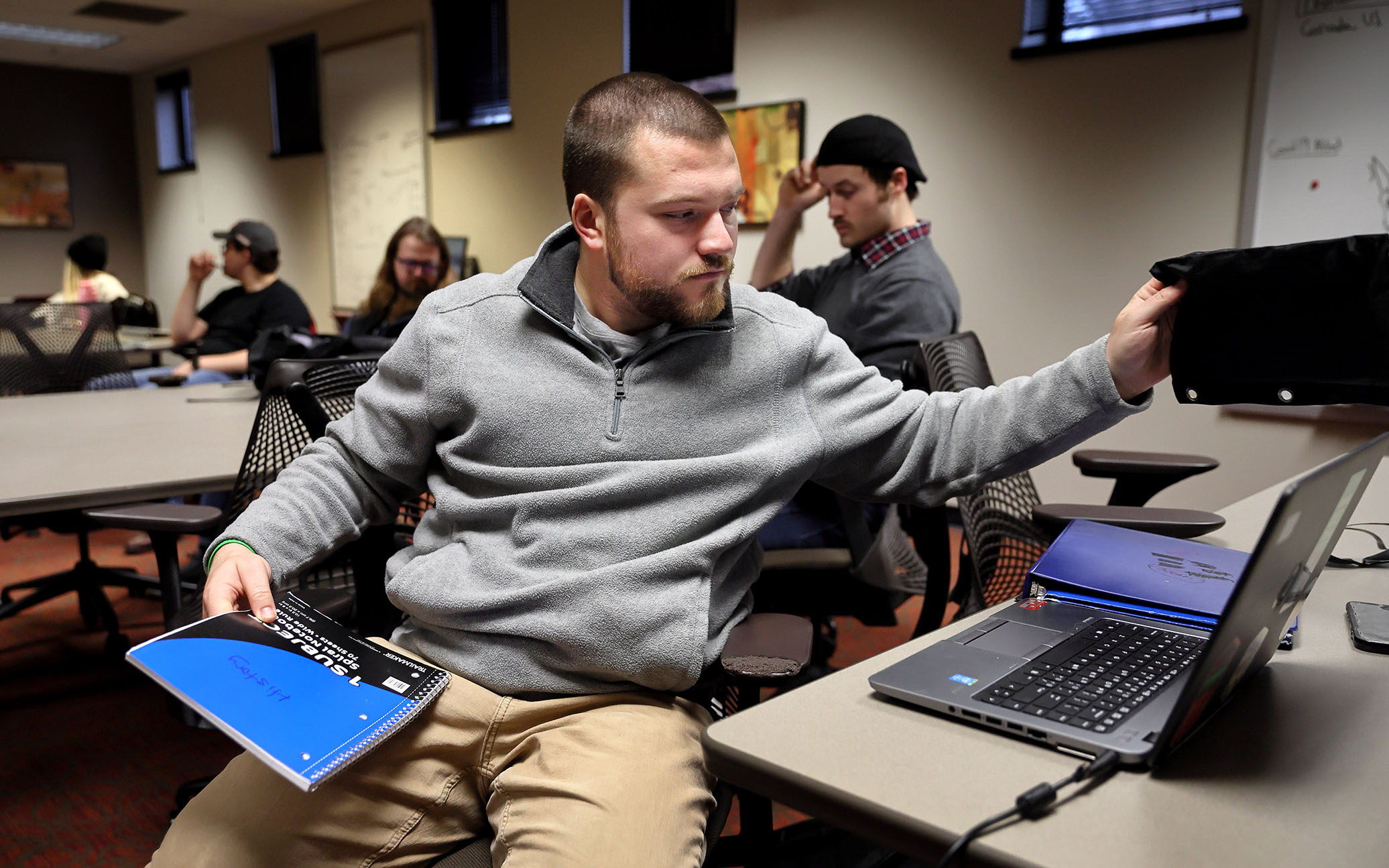
Conner Stewart will get prepared for the beginning of his historical past class on the University of Missouri-St. Louis. Stewart benefitted from an UMSL program known as Link that helps college students on the autism spectrum with academic, life and profession preparation expertise. (David Carson/St. Louis Post-Dispatch/TNS)
ST. LOUIS COUNTY, Mo. — The first time Hailey Hall went to school, it was 2008. She lived in Georgia and had been recognized with autism 4 years earlier than.
In highschool, the analysis meant she had entry to smaller lessons and a remedy group that helped with social expertise. But when school began, that every one stopped.
“I used to be chargeable for every thing,” mentioned Hall, 35, who lives in Ballwin. She ended up dropping out.
Advertisement – Continue Reading Below
Since Hall was recognized twenty years in the past, the variety of youngsters with autism has shot up from 1 in 125 to 1 in 36. Now, school directors throughout the nation are responding, coaching workers, adapting to studying variations and selling self-advocacy. Just a few native universities are even touting some success: Small steps, they are saying, seem like working.
Webster University has a useful resource middle the place college students be taught methods to deal with the trials of faculty.
St. Louis University assembled a sensory room, with a tabletop fountain and a miniature rock backyard. It had a whole lot of visits final yr.
And the University of Missouri-St. Louis has a two-year program that fosters interpersonal and life expertise.
“It’s a retention concern,” mentioned Jonathan Lidgus, the director of UMSL’s Office of Inclusive Postsecondary Education. “What can we do to assist them persist by their undergraduate diploma, to assist them unlock their subsequent steps?”
Autism spectrum dysfunction, a developmental incapacity, has no correlation with intelligence, and is marked by issue with social interactions, communication deficits and repetitive behaviors.
And, for a lot of, it makes school tough: The charge of completion for college kids with autism lags that of the overall postsecondary inhabitants, 39% to 59%, in accordance with the National Institutes of Health.
In elementary and secondary colleges, variations — as mandated by the federal Individuals with Disabilities Education Act — have grow to be routine. Fidget toys and motion breaks cut back stress and enhance focus. Visual cues and written directions make clear each day expectations.
After highschool, the authorized framework round incapacity adjustments. Adult college students are coated by the Americans with Disabilities Act, which prohibits discrimination however has no metrics for particular person progress. The onus to articulate wants and ask for help shifts from the varsity to the coed.
Higher schooling has been inching towards inclusion, advocates say, however there’s a lengthy method to go. And the measures taken — like classroom modifications or informational campaigns — are largely voluntary.
“Colleges have been sluggish to catch on,” mentioned Lee Burnette Williams of the College Autism Network, a nationwide advocacy and analysis nonprofit.
“It appears like these college students have simply fallen off a cliff of help,” mentioned Burnette Williams. “What inevitably occurs is that they don’t succeed.”
Almost all campuses have an workplace that gives sources to college students with documented disabilities, however complete help applications for autism are uncommon. The first one, at Marshall University in West Virginia, opened in 2002.
Today, there are about 100 such applications, in accordance with the College Autism Network.
‘Everything seems so completely different’
The transition to school is a jolt for nearly any 18-year-old. No one checks to ensure you are finding out, and even attending class. Sleeping and to eat habits fluctuate. The guardrails of childhood are gone.
Students with autism typically additionally battle with isolation, unpredictable schedules and an elevated emphasis on grades, consultants say.
“Everything seems so completely different,” mentioned LaToya Griffin, the educational coordinator at Webster University’s useful resource middle, generally known as the Reeg. “We are educating college students to self-advocate to allow them to come on the campus and thrive.”
Dara Massey, 24, earned her affiliate’s diploma earlier than enrolling at Webster within the fall of 2022. Getting her level throughout to professors and classmates has all the time been a problem.
“I generally ramble,” mentioned Massey, who lives in Ferguson.
But the Reeg has given her methods: Take a deep breath. Write it down. Massey, who’s majoring in animation, expects to graduate this spring. Her drawings assist her talk, too.
“I like creating characters to inform completely different tales,” she mentioned.
Three years in the past, SLU’s Center for Accessibility and Disability Resources utilized for a $3,000 grant to construct a sensory room on campus. The therapeutic areas — commonplace in grade colleges — home gadgets like bean luggage, weighted blankets and bubble tubes that individuals can use to calm themselves or regain focus.
Occupational remedy professor Sarah Zimmerman enlisted her college students to design SLU’s model, which features a “cocoon” swing and adjustable music and lighting.
“There’s not numerous areas to decompress and recharge,” mentioned Zimmerman. “Why would that not profit our children in school?”
It took a while for the room to catch on. In its first yr, solely 5 college students visited. Last yr, greater than 230 college students accessed the area, signing up for 30-minute slots with an app.
Kayla Baker, a junior from Overland finding out schooling, makes common appointments there for “an escape from the day-to-day stressors that include autism.”
As she goes about her routine, little issues — issues many individuals are oblivious to — drain her: small discuss, eye contact, background noises.
“Those are all guidelines gadgets I’ve to manually take into account all through the day,” mentioned Baker, 21. “Even with all of the lodging on the earth, I can by no means not be autistic.”
The long-term purpose is to construct one other sensory room on the reverse finish of campus, mentioned Kendra Johnson, the director of SLU’s useful resource middle.
“It’s costly to begin, and it’s a must to replenish it,” Johnson mentioned. “But it might be very useful.”
‘Life-changing’
The Link program, for college kids with autism at UMSL, launched 5 years in the past. It follows the mannequin of the college’s Succeed initiative, which serves college students with mental disabilities.
Each semester, a pair dozen college students enroll in Link, at a price of about $2,600, plus common tuition. The program, which lasts two years, goes past lecturers, masking impartial residing, interpersonal expertise and profession planning, mentioned Lidgus, the UMSL director.
When college students full Link, they earn a certificates or proceed on towards a four-year diploma.
For a very long time, a credential of any sort appeared out of attain for Conner Stewart, 24.
“School isn’t that straightforward,” mentioned Stewart, who lives within the Central West End.
But Link, which he completed final yr, benefited him contained in the classroom — with tutoring and prolonged check occasions — and out. Stewart realized to navigate the MetroLink, purchase groceries and handle his cash. He practiced writing a resume and doing interviews after which landed a job on the St. Louis Zoo.
Stewart nonetheless meets with a coach as soon as every week. Now he’s working towards a bachelor’s in historical past, although his childhood on a farm and his work on the zoo are pulling him towards one thing with animals.
The school expertise isn’t all the time rosy. Some professors usually are not as understanding. Some classmates usually are not as pleasant. But most are. And Link has put Stewart on a path he probably wouldn’t have thought of in any other case.
“It’s been life-changing,” mentioned his mother, Charlene Stewart of Millstadt.
‘A way of belonging’
Hall, who dropped out of Georgia Gwinnett College greater than a decade in the past, by no means thought she’d return. But her husband inspired her to provide it one other go, and she or he enrolled in St. Louis Community College in 2022. On the Meramec campus tour, she noticed the Access Office for college kids with disabilities.
The variety of college students with autism utilizing the Access Office has nearly tripled during the last decade, from 54 to 158, in accordance with director Amy Bird. A real depend of scholars with autism is tough as a result of it’s as much as them whether or not they disclose a analysis.
The Access Office workers identifies, in partnership with the coed, what sorts of interventions will facilitate their studying, from sporting headphones throughout lectures to including closed-captioning to movies. “Instructor notification types,” which define wanted lodging, present a directive to professors who may in any other case be left at nighttime.
But the workplace’s goal is not only about educational success, mentioned Bird.
“Everyone desires a way of belonging,” she mentioned. “Finding your individuals once you’re right here is essential.”
The area has grow to be a touchstone for Hall, who’s finding out high-quality arts. She works there a couple of hours every week as an assistant and checks in with Bird or different workers members on her off days.
“They’re very pleased to have me there,” mentioned Hall, “which is a pleasant feeling.”
© 2024 St. Louis Post-Dispatch
Distributed by Tribune Content Agency, LLC
Read extra tales like this one. Sign up for Disability Scoop’s free electronic mail publication to get the newest developmental incapacity information despatched straight to your inbox.